The Ground Beneath Davenport: A Short Geology Lesson
If you live in Davenport, you probably don't spend much time thinking about what's under your lawn. But the soil beneath your home is the single biggest factor in whether your basement stays dry or turns into a damp, cracked headache. The Quad Cities sit on a unique geological stack: a thick layer of wind-blown silt called loess on top, and dense glacial till underneath. Understanding how these two materials behave is the key to understanding why so many local foundations crack and leak.
Loess is a fine, powdery sediment deposited by wind over thousands of years. It's common across the Mississippi Valley, and it has a frustrating habit: it holds together well when dry but loses strength quickly when wet. Glacial till, meanwhile, is a mix of clay, sand, gravel, and boulders left behind by ancient ice sheets. It drains poorly and expands when saturated. Together, these layers create a foundation environment that is far less stable than the sandy or rocky soils found in many other parts of the country.
Why Loess Silt Foundation Problems Are So Common Here
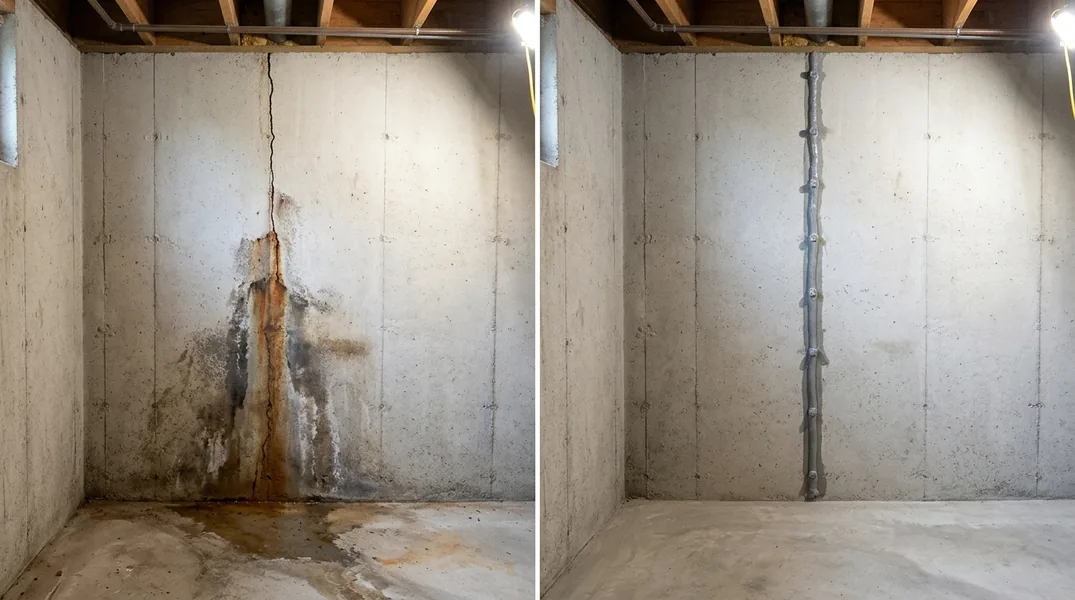
The loess silt foundation issue comes down to water. When loess gets wet, it can collapse or shift, and when it dries out, it shrinks. That cycle of expansion and contraction puts constant pressure on your foundation walls. Over time, this silt soil movement creates hairline cracks that widen with each wet-dry season. Homeowners in older neighborhoods often notice stair-step cracks in block walls or vertical cracks in poured concrete, both classic signs of soil movement rather than simple settling.
What makes this worse is that loess is highly erodible. Water running along the surface or through poorly graded soil can wash fine silt particles away, leaving voids under footings. When a footing loses support, the foundation above it drops, and cracks spread. If you've noticed new cracks appearing after a heavy spring rain, that's not a coincidence. It's the Iowa soil basement leaks pattern playing out in real time, and it rarely fixes itself.
Glacial Till and the Water Table: A Bad Combination
Underneath the loess, glacial till acts like a leaky bucket. It doesn't drain well, so water from rain and snowmelt tends to sit in the soil rather than percolate down. During wet seasons, the water table rises, and hydrostatic pressure builds against your basement walls. That pressure forces water through even tiny cracks and porous concrete, which is one of the most common basement leak causes in the region. It also explains why some basements stay dry for years and then suddenly start seeping after an unusually wet spring.
This is where Foundation Waterproofing becomes essential. A proper solution has to account for both the expansive clay in the till and the water pressure it creates. Simply patching cracks from the inside is a temporary fix at best. Long-term protection usually involves managing water before it reaches the foundation, which is why exterior solutions and drainage systems are often recommended for homes in Bettendorf and across the Quad Cities.
Signs Your Davenport Foundation Is Feeling the Pressure
Not every crack means disaster, but some patterns should get your attention right away. Vertical cracks that are wider at the top, horizontal cracks in block walls, and cracks that let in daylight are all red flags. So are doors and windows that suddenly stick, uneven floors, and white powdery deposits (efflorescence) on basement walls. These Davenport foundation cracks often trace back to the soil movement described above, and catching them early can save you thousands in structural repairs.
Water is the other telltale sign. Damp spots along the base of walls, a musty smell, or visible seepage after storms all point to basement leak causes that go beyond simple condensation. If you're seeing any of these, it's worth getting a professional assessment before the next wet season. Homeowners in Eldridge and Blue Grass face the same soil conditions, so the warning signs are consistent across the area.
Basement Waterproofing Near Me: When to Call a Pro
If you're searching for basement waterproofing near me in the Davenport area, the right time to call is before you have a finished basement full of ruined carpet. Small cracks can sometimes be addressed with sealants, but when water is actively entering or the foundation is shifting, DIY fixes tend to fail. A professional evaluation looks at grading, downspouts, soil conditions, and the foundation itself to identify the real source of the problem rather than just the symptom.
Depending on what's found, solutions may include an Interior Drain Tile System to capture water and route it away, or Exterior Basement Waterproofing to stop water before it reaches the walls. Many homes benefit from Basement Waterproofing that combines both approaches. The right plan depends on your specific soil, foundation type, and water pressure, which is why an on-site inspection matters more than a phone quote. You can request a free estimate to get started.
Basement Waterproofing Cost in Davenport: What to Budget
Homeowners often ask what waterproofing will run, and the honest answer is that it varies. A simple crack injection costs far less than a full interior drain tile installation, and exterior work involves excavation that adds to the total. Factors include the length of the foundation, the severity of water intrusion, whether sump pump upgrades are needed, and accessibility around the home. Because loess and glacial till create different challenges than sandy soils, local pricing reflects the specific conditions crews encounter here.
The best way to get an accurate number is to have a professional look at your foundation and explain the options. Skipping that step and guessing often leads to paying twice: once for a cheap fix that fails, and again for the real solution. If you'd like to understand what your project might cost, call Davenport Waterproofing at (563) 275-6972 or request a free estimate. Protecting your foundation now is almost always cheaper than repairing structural damage later.
Looking for a professional basement waterproofing contractor in Davenport? Davenport Waterproofing responds fast for all your basement waterproofing needs.
Get a Free QuoteOur services: Basement Waterproofing · Interior Drain Tile System · Exterior Basement Waterproofing